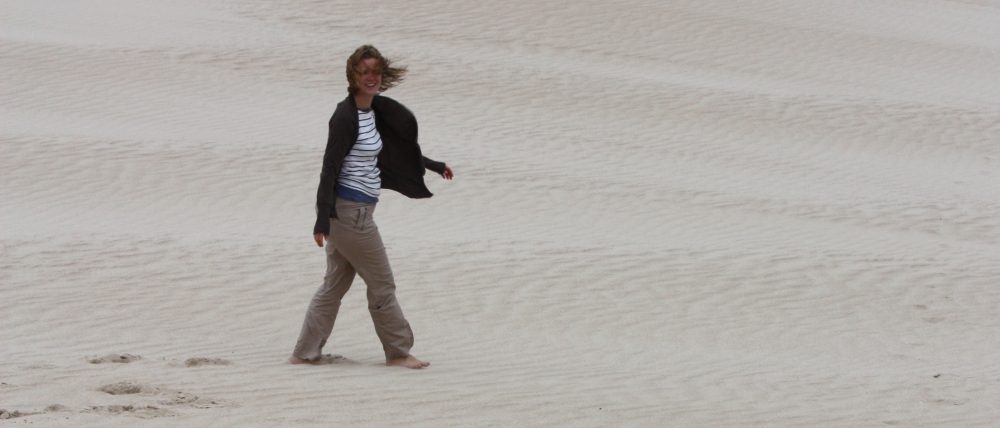
My name is Ingrid and I am a storyteller

I love stories, I always have, and I come from a long line of storytellers, both on my mother’s and my father’s side. When my sisters and I were little, we would huddle together under a blanket as my dad, in a deep deep voice, told scary stories of the Big Bad Wolf. In my mind I can still see the picture he painted: the ramshackle cabin in the deep dark forest under towering fir trees, and the telephone the wolf always used to call the pigs to trick them to come to different places where he planned to catch and eat them. I get goose bumps just thinking about it.

But I didn’t realize what a great influence stories have had on me and almost everything I do until relatively recently. I remember being about thirteen years old and struggling to remember important dates when studying for a history test in school. In my desperation, realized that if I read my history book like a story, it would be much easier to remember. And presto: I aced the test. Without knowing it I developed a tool for myself, which I use again and again, whether with my kids, with colleagues, with clients, or with students. If I prepare a lecture, for example, I weave a story of the theories, cases, and examples. If I didn’t, I wouldn’t be able to even remember what I am supposed to talk about for 90 minutes. And when giving talks, I don’t think of them as presentations, but rather as stories I tell – again, more for my own sake than anything else. And it works; most people seem to like stories and I find that I can engage them in this way.

So when I saw one of Brené Brown’s TED talks a while back, I felt all the pieces of the puzzle just fall into place. I liked her talk – it’s definitely worth a watch – but it’s what she calls herself that I love. She calls herself a researcher storyteller, and when I heard that I though wow, that’s exactly what I want to be! And I am. Regardless of what I’ve done in my previous career or what I end up doing in the future, I have always been and will always be a storyteller.

I’m going to end with a quote I found in a novel a few years ago. I don’t remember much about the novel, except that I liked it, but apparently there was one passage that made an impression because I wrote it down on a piece of scrap paper that I found the other day when sifting through old piles. So here it is, Brian Morton in Starting Out in the Evening:

“The story-making organ never sleeps… The world, the human world, is bound together not by protons and electrons, but by stories. Nothing has meaning in itself: all objects in the world would be shards of bare mute blankness, spinning wildly out of orbit, if we didn’t bind them together with stories.”

Isn’t that just so true?

Things I would do

I have a dream. In fact, I have many dreams – things I fantasize about doing and lives I dream about living if I didn’t do what I do now. Especially when I’m feeling stressed and overwhelmed by it all, I think of all the things I could do instead.

I would live in the country and have horses. Be close to animals and nature. Listen to the sound of the sea and the rustling of the leaves in the trees, and I wouldn’t have to deal with people, intrigue, and office politics.

I would be a painter and I would paint fulltime. I would be creative and create beautiful things all day long. I would surround myself with textures and colors and steaming cups of coffee. Possibly in Tuscany.

I wouldn’t live in the country, I would move right back into the city and go to museums more often than I do now, see more movies, and pop down to my favorite corner café for coffee. Because I would have a favorite corner café, which I don’t where I live now. I would live in an old building with high ceilings and huge windows and I wouldn’t have a garden because then I wouldn’t have to feel bad about not having the skill or the energy to take care of my over-grown garden.

I would have a garden and I would be absolutely fantastic at gardening. I would know all about plants and what they need to grow. I would watch little saplings develop into gorgeous flowers and trees and I would enjoy the slow pace of it all and I would surround myself with fragrant beauty.

But then I think about what I heard a wise person say not too long ago. She said maybe you should think twice before making your hobby your day job. Because a hobby is an escape, a place you can go to get away from it all, and when you make it your job, suddenly it starts to become a source of stress and anxiety. And I realize that some things I just love too much. Like horses and painting. I horseback ride to get away and I love that being with horses is completely worry-free for me. And I paint only when I want to, and when I have the time and the headspace. I never have to create under pressure when I paint, and I kind of want to keep it that way.

So as I sit here among my weeds in my over-grown garden, I realize that I don’t really want to move to the country. And I don’t really want a corner café either (ok, I do, but I’m also really happy where I am now). Maybe I’ll learn how to garden some day, or maybe I won’t. But it doesn’t matter. In the meantime I realize that no matter what work I do, whether it’s a dream job or not, there is always going to be stress and there is always going to be anxiety, and I will always dream of doing something else. Because the truth is, dreaming big is just the best thing there is.

Opting out = downshifting? (and some advice on how to deal with stress)

A common response I get from people when I tell them that I research opting out is a knowing look, a nod, and the comment “downshifting”.

And I answer, “Well yes, downshifting is a way of opting out, but it is not the only way. “

A few years ago, downshifting became quite the buzzword. It was trendy and you would see stories of people downshifting all over the media. According to Wikipedia, downshifting is defined as “a social behavior or trend in which individuals live simpler lives to escape from what critics call the rat race of obsessive materialism and to reduce the “stress, overtime, and psychological expense that may accompany it”[…] Downshifting, as a concept, shares many characteristics with simple living.”

Granted, those who downshift – much like those who opt out – most likely go through a journey where they gain a sense of authenticity; they start to live on their own (simpler) terms and throw the pressures of career and consumerism to the wind. However, the thing is, of those I have interviewed, few if any have actually downshifted. Yes, they may consume less out of necessity. Opting out of a high-powered career will inevitably mean less income, hence the decrease in spending power. And yes, they might take their life down a notch from break-neck speed to a more healthy rhythm. But that does not necessarily mean that they have downshifted, that they have embraced the simple life. On the contrary, my research has shown that many don’t necessarily work less at all, but have more power regarding where, when, and how they work, which provides them with coherence and just makes their lives easier to handle.

Which brings me to my second point. Not only do many people assume that opting out is the same as downshifting, they also sometimes mistakenly assume that I am an expert on how to downshift. Not too long ago I was asked if I would meet for lunch at some point to help the person in question create a plan for how to scale down and slow down, i.e. downshift. I mentioned this to my family in the car the other day, and my kid, who is very perceptive, exclaimed, “But you don’t know anything about that. You need help with that too!”

I rest my case.

But then my husband suggested I just tell people what I have done to deal with the stress in my life, when asked for help. Excellent idea, why didn’t I think of that? Well here goes: about a year ago I started practicing yoga and I started with Adriene’s 30-day yoga challenge. And it has helped me. It gives me time to breathe, reflect, and accept, while also making me physically stronger and more grounded. So that is now going to be my answer when asked for advice: Google ‘Yoga with Adriene’! I’ve even added the link to save you some time: https://www.youtube.com/user/yogawithadriene

I’ve been lucky

One of the biggest differences I have found between men and women in my research is the amount of luck they attribute to their career success. Men will often talk about their success as something planned and premeditated, whereas women will often say that opportunities just came up and that they’ve been really lucky.

This ‘male’ attitude and confidence is good to have in our world of work, where you’re expected to go out and get whatever it is you want and to constantly strive to become faster, higher, stronger. Research has shown that women are more careful when asking for promotions and applying for new positions; they usually play down their competencies while men tend to claim they are better at something than they really are. Also, women are not as good at negotiation terms as men are. All this of course adds to the gender inequalities women continue to face at work and HR professionals often work with women to give them more confidence in themselves, which is important of course.

But I’ve been thinking. My last blog post ended with me saying how lucky I am, and as I published that post I wondered whether I would have ended with a comment on how hard I have worked had I been a man. And it is true, I have worked hard to be where I am, and I continue to work hard. Sometimes I think I need to be kinder to myself, although I am also proud of having such a strong work ethic. I think it is important and admirable to work hard, just like all those men and women I’ve interviewed have done (even though the women claimed to have been lucky).

However, as I work hard, I am also aware that it is also luck and circumstance that have made me who I am. I’m lucky to have been born to my family, in my country – a country at peace and a welfare state where we can’t even imagine the hardship that so many people in the world experience. These circumstances put me through a good school, gave me an education, and put me in touch with people who have been able to help me in different ways on the road to where I am today. Whether or not I work hard, I am hugely privileged, and for someone who hasn’t been as lucky, it doesn’t matter how hard they work, they still won’t enjoy the success that I do.

So yes, we do work hard, but more of it than we like to admit is really just down to luck. Maybe we shouldn’t sigh when women claim they’ve just been very lucky. Maybe we should nod, and recognize it instead as the wise insight into the state of things that it is.

In seventh heaven

This is my seventieth blog post. Come November, I will have been a blogger for two years. Had someone told me this two years ago today – about three months before I started blogging – I would never have believed them. That was something other people did. Who knew I had so much to say?

Seven years ago this summer I opted out and in. I opted out of a business career and became a sociologist and academic. Had someone told me that seven years earlier, I would just have laughed dismissively. That was not for me. But then one day I started playing with the idea of going back to university. I knew it would entail some sort of a change since I also knew that having a PhD isn’t always a forte in the business world, where it’s good to be qualified but not overqualified. However, little did I know what a lifestyle change it really would entail. Not so much on the outside, I still look the same and act the same. No, the change is more on the inside. It’s like a whole new world has opened up for me. So what do we learn from this? I guess John Lennon had a point when he said, “Life is what happens when you are busy making other plans.”

In seven days my summer vacation is up. Anticipating the end of my stay on this paradise island, where I spend much of my time off – where time is unimportant and schedules nonexistent – always makes me a bit blue. Still, I have exciting things to look forward to. In September I will embark on my project, which really is a dream come true. One that I almost gave up on, but then thought, nah, I’ll give it one last shot.

It’s seventeen weeks since my dad passed away. A friend said that although people tell you to get over it you never really do. And it’s true. Although no one has said that to me, the emptiness he left behind is still as big as on the day he died. And that’s exactly the way I want it; I want to feel the emptiness because it keeps him close. As I learn to live with it, it still continues to kind of cast a melancholy tint on things. It’s hard not being able to share exciting news and talk about things the way we used to.

As I sit here, I ponder the bittersweetness and irony of having and not having, wanting and not wanting. But I guess that’s pretty much reflective of life in general. Life is not only sunshine and roses, it’s complicated. But still, I’m very lucky.

It’s not always about kids

I was interviewed for the radio a couple of days ago. It was a program about combining work with children, and I was contacted as an expert on the topic. It was a good interview; I got to say what I thought was important. However, I was a bit disappointed because it turned out they cut the most interesting part. Towards the end of the interview I was asked whether or not I think it’s fair that people who are single or don’t have kids have to pick up the slack when people with kids need to go home (after a full day’s work). Finally it was getting intriguing but for some reason they didn’t find it relevant or that it added value.

People without children are often expected to put in hours that people with children aren’t simply because anything other than children doesn’t seem to be a viable reason to go home when there is work to be done. Although let’s face it, there is always work to be done, it really never ends. Well, I guess we should be grateful that employers realize that kids do need taking care of and that in this day an age it´s generally frowned upon to keep parents from doing so. However, every once in a while I hear a childless person who has had to put in the extra hours complain that it is unfair, and rightfully so. It is unfair.

The thing is it isn’t only married people with children who have families. Most people have families, even people who are single. The so-called nuclear family is not the only type of family you can have. For some reason we assume that kids are the only ones in society who need care. However, other people may need care too, like ageing parents or ailing siblings and friends, and although this may come as a shock to some, childless people may also have care responsibilities.

But it isn’t only care responsibilities that should factor in when deciding whether or not a person should be asked to work long hours. Let’s not forget that there is more to a balanced life than work. And yes, people who are single also want and need balance in their lives.

When I was working on my PhD, I started interviewing women both with and without children, because I was convinced that children are not the main reason people opt out. Well, I soon realized that I needed to focus on women with children simply in order to add to that debate, but get this: the women with and without children all basically talked about the same thing. They had the same reasons for leaving and wanted the same types of things for the future. Although some of them didn’t have to juggle a career with children, their narratives were still strikingly similar.

Care responsibilities really shouldn’t be seen as a problem. And although those who have to pick up the slack tend to feel irritated and fed up, the issue really isn’t that people with children can’t work hard enough. The issue is that many employers don’t recognize that it is neither sustainable nor okay to monopolize someone’s life. Maybe we shouldn’t be asking anyone to work around the clock, whether or not they have care responsibilities.


My kids are ok

Mothers sure don’t have it easy. They tend to be the most scrutinized people in society, and although mothers and fathers together create and raise children, we have incredibly high expectations. Good enough mothering, although a good and healthy concept, has been overshadowed by what researchers call the intensive or scientific mothering ideology – what I like to call ‘project motherhood’. Good enough mothering is definitely not good enough; we expect mothers to be childcare and child development experts, not to mention everything else they need to be – everything from child psychologists to nutritionists. Mothers are also considered mainly responsible for what kinds of adults their children grow up to become: if they become successful, the mother is considered to have done her job well; but if they for some reason don’t, mothers are looked to for blame.

No wonder women often feel insecure in their mothering roles. And the way this plays out is that it is mothers who are generally the most critical of other mothers instead of giving each other much-needed support. It’s understandable, although also very unfortunate. With all the pressure to be the perfect mother (and please note: there is no one perfect way to be a mother. Every mother, child, situation and family is unique and all we can and should do is the best we can. Yes, good enough should really be good enough.); with all the pressure it is natural to feel insecure and mothers look to each other to check that they themselves are ok.

I’ve been there. I have two kids and I have tried to be the perfect mother like everyone else. At times I have also been critical of other mothers to confirm that I was doing ok. This is not commendable and I don’t think I was even aware of it at the time. I wasn’t openly critical though, I have been taught well by my parents: if you can’t be kind and supportive, maybe it’s best to just not say anything at all.

But still I’ve been there, although it was many years ago. Now that I have a tween and a teen, the pressures of being a perfect mother don’t really get to me so much anymore. However a while back I found myself speaking to a person who is on maternity leave and probably agonizing about when the right time is to put her child in daycare and go back to work. We were talking and over ten years after the fact, my choices of how long I stayed at home with my kids were questioned. I’m from Finland and both my maternity leaves have been average for Finnish standards and quite long out of an international perspective. I was on leave slightly longer with my first child and slightly less with my second, as my family was dependent on my income at the time. Both my children have developed to become happy, well-balanced, delightful human beings, so I tend to not worry anymore about what I did or didn’t do when they were infants. Still, it felt like this person was judging me and questioning my choices after all these years when she sounded surprised that I didn’t keep my children at home longer.

It was a weird sensation. I hadn’t thought about it for years because it just feels completely irrelevant to my current situation even though it is obviously top of mind for her. As a mother, admittedly, I may still be a little sensitive when it comes to criticism, but still. We all have to make our own choices based on who we are, what our children need, and what our situation is. We shouldn’t be so quick to judge, none of us really have any idea where anyone else is coming from. We just do the best we can. And besides, why question my choices after all this time? My kids obviously turned out ok.

No time to waste

I made a new friend a couple of days ago. She’s a woman I’ve known for years, but not very well. She’s a friend of the family, and I see her on occasion at family gatherings, although we have never gotten a chance to really get to know each other. I’ve always found her very intriguing, and a little intimidating too I have to admit. She comes across as very strong, intelligent, and opinionated, and she definitely doesn’t sugar coat things.

A couple of months ago we were at a family lunch and once again she and I were seated at opposite ends of a long table. During the meal I would sometimes glance at her, and as usual I felt sort of mildly bummed that others were getting to talk to her and not me. Well, guess what. As the lunch was drawing to an end, she came up to me as she was leaving. She told me that she suspected that we have a lot in common but that we never get to talk to each other at these things. Yes, that’s right, that’s what she said! And I told her I felt the same, although what I was really thinking was ‘I think you are so interesting’ rather than ‘I think we have a lot in common’, but whatever. Details…

We agreed that we should meet up for coffee and get to know each other a little better. And so we did. I didn’t want to put it off for very long, I mean the woman is well into her 90’s, and it kind of felt like if I’m going to get to know her, it’s now or never. And I wasn’t disappointed, and I don’t think she was either. We had a lovely chat and we exchanged phone numbers and hopefully we will talk over coffee again sometime soon.

But it got me thinking. How many of you see family or friends all too seldom? I certainly do. I have some close friends that I haven’t seen for ages. We tell each other that we really should get together at some point, but since there’s no sense of urgency we just don’t seem to get around to it. We’re so busy and overwhelmed in our every-day lives – juggling work and family and whatnot – that we don’t get around to making time for each other. Even though it’s seeing friends and family that kind of makes every-day life worth living. So maybe we need to make more of an effort, even though we’re not pushing 100 just yet.

2014 in review

Not bad for my first six weeks as a blogger! I’m especially proud to have readers in 30 different countries!

Happy New Year 2015! May it be a year of love, happiness, health, and prosperity. And success – however you define it!

The WordPress.com stats helper monkeys prepared a 2014 annual report for this blog.

Here’s an excerpt:

A San Francisco cable car holds 60 people. This blog was viewed about 1,000 times in 2014. If it were a cable car, it would take about 17 trips to carry that many people.

Click here to see the complete report.

Season’s Greetings

I’m taking a short break over the holidays but will be back with a new post right after the New Year.

In the meantime, have a Very Merry Christmas and a Happy New Year 2015!

“To dare is to lose one’s footing momentarily. Not to dare is to lose oneself.”

― Søren Kierkegaard